Tips from Claims Manager David D'Agostino

Isaac Cymrot:

Welcome, to the second installment of DisasterMan. I'm your host, Isaac Cymrot, the director of sales and industry relations for Travel Insured International. Today, my guest is David D'Agostino, the claims supervisor for Travel Insured. Our topic today is all about claims. Common misconceptions, mistakes that people make, tips that will help you process your claim faster, and then we're gonna revisit the story from last month with Nolan Burris and the unfortunate incident with his mom and how travel insurance could have helped him out.

Let's get started right away, 'cause we have a lot to cover in a short period of time. First, Dave, if I could just ask you to go through a brief explanation of the claims process so that everybody is educated on what they need to do and how they can get through the unfortunate situations that come up during travel.

David D'Agostino:

Well first off, we need notification of a claim. That can be done via the internet, by logging in and entering your policy number and last name information. Also, you can call us and we can set up a claim that way. We'll initiate the claim in our office, we'll send out forms via e-mail or mail, specific to the type of claim. There's trip interruption, trip cancellation, there's medical claims, baggage, and we'll send out the appropriate forms to you or to an agent, if an agent wants to assist their clients.

And then from that point on, we wait for the insured or the agent to send information back to us. We review the information upon receipt to make sure that all the information that we're looking for and required by underwriting, is in the claim file. Many of the things that we need for trip cancellation: proofs of payments, a refund statement from the travels supplier, along with the terms of conditions. If there's airfare involved, you need to check if there's refunds on the airline tickets. We oftentimes - many times, call the airlines ourselves to assist our clients and the agents to confirm refunds and cancellations.

And that works the same with all the other types of claims. We work with the agents or supplies to get information that we need to confirm proof of loss.

Isaac Cymrot:

And one thing I'll add to that too is if there's a baggage claim or trip delay, obviously copies of receipts. If you had to purchase anything that you - like for example, an extra overnight hotel stay that was unexpected for travel delay, we would need a copy of the receipt from the hotel.

David D'Agostino:

That's correct.

Isaac Cymrot:

Meals, receipts from the restaurant, that kind of thing. So keeping documentation is always the most important thing.

David D'Agostino:

Right. Obtaining receipts for Taxis to go to the hotel, verification from the airlines, that can be obtained sometimes at the airport or sending an e-mail afterwards when getting back home, with providing the flight information, the ticket numbers, that sort of thing. Receipts, it's important that you submit it all to us. We'll determine at the time of claim, you know, what is payable, what we can pay per the policy limits.

Isaac Cymrot:

Yep. Now it's obviously easy for you and I to sit here and say the claims process is easy, 'cause we deal with it every day and this is what we do. Can you detail a couple of the common mistakes that people make, or certain things that might delay us paying a claim, so that that way people know, hey, these are the biggest things that we need to focus on when getting claim information in?

David D'Agostino:

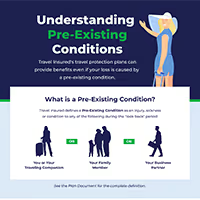
Sure. Some of the items that people get confused on or make mistakes is some of our policies preclude preexisting medical conditions, where we have to go back to the physician or other providers to determine whether this condition that caused you to cancel is a pre-existing condition. Another issue is airline tickets. 99 percent of the tickets say, "non-refundable, non-transferable," but that's not the case. We found in the industry that the airlines are now leaning towards refunding taxes, oftentimes they're refunding the full ticket due to an illness, if there's a death or hospitalization, they'll refund the full ticket.

But a lot of the industry is going towards refunding taxes or portions of the ticket. Oftentimes we see agents or insurance sending us "terms or conditions" and we still need a refund statement, which basically confirms that the trip was canceled. Particular case was we had a claim where an individual sent us terms and conditions and says, "Why do you need a refund statement if it says 100 percent there?" We called the agent to obtain the refund statement and she says, "What are you talking about? This person went on the trip." So we need proof of loss to cover all avenues of the claim and to determine that it is a payable claim.

Isaac Cymrot:

Can you also speak to the medical side? I know a lot of the questions I receive from agents typically revolve around a medical claim, a trip cancellation due to medical or medical claim where we're waiting on documentation from a doctor.

David D'Agostino:

That can slow it up. The doctors are busy in today's world, you know, people are sick and they're not gonna jump right away and handle our request immediately. We send a fax to the physician, oftentimes they want it mailed, which slows it up even more by a few days. By faxing it, we have to literally fax our request to them with an authorization. Sometimes they don't accept our authorization so we'll have to go back to the insured with their specific authorization and what we need, so it slows it up. It can take generally - we follow-up weekly with the airlines, with the doctors, with any supplier with what we need if we send something out to them. But the physicians are - you know, it's tough when you're trying to get that information from them.

Isaac Cymrot:

Yep. I think this is a good transition into the next question which is. What are some of the tips that people can take away from this to really speed up the claims process, because if we get the information all at once, it doesn't take long to process a claim.

David D'Agostino:

Right. A complete claim is helpful, it's done immediately. We've seen those. It's helpful; it's beneficial to the client, beneficial to the agent. No one is angry, no one is upset. When we have to request information, things to help speed it up is to contact the physician, check with us. We do send out notifications that we're contacting the airlines or we're sending notification to the doctor for medical, so that alerts you. If you can call us, if you want to find out what the status is, our office is open 8:00 to 5:30 PM, Monday through Friday, but contacting the physician helps. And exactly what is needed, that helps speed things up.

Contacting the airlines, we know it's tough to get a hold of a live person at the airlines. Oftentimes e-mail does work best, which is what they want. But getting a hold of them helps us and helps them speed it up.

Isaac Cymrot:

Yep. The more that's presented up front, obviously -

David D'Agostino:

Right.

Isaac Cymrot:

- helps speed up the process. And I think -

David D'Agostino:

And our claim forms also provide a checklist on what's needed. And if an item is missing, we unfortunately have to go back to the insured or we have to go to the agent or suppliers to get that.

Isaac Cymrot:

Yeah. And I think an important note too is if you have questions, please call your claims analyst.

David D'Agostino:

Right.

Isaac Cymrot:

That checklist is provided but maybe you have a question on exactly what we're looking for and the best way to get us the information as quickly as possible, is to know exactly what to send and if you have to, please call us and we will be able to detail exactly what's needed so you can send us the right information the first time and get the claim processed as quickly as possible.

David D'Agostino:

Right. We understand it's difficult and some people don't understand what the terms and conditions are. Some people don't understand why we need proof of payment and why we don't accept an invoice. We just don't accept it, its underwriting requirements where we need canceled checks, credit card statements. All that information can be redacted with account numbers and all other transactions, all that information is secure and held here at a private location.

Isaac Cymrot:

Cool. And the last thing that I want to just touch on today is revisiting the story from Nolan Burris for last week. For those that missed it, Nolan lives in Vancouver and his mom was visiting from Oklahoma. She had an unfortunate incident, stepping off of a ferry, slipping. It was just an accident and she had to go to the hospital and she had a fairly significant amount of medical bills. Unfortunately, she didn't have an insurance policy. But if she did, can you speak to that specific situation. 'Cause I know this is always one of the questions I get from agents is, "If somebody get's hurt while traveling and they have an insurance policy through you, what is the best course of action?"

David D'Agostino:

The best course of action, whether it's a simple cut, or a fall, or a serious injury like this, is to contact the assistance company. The assistance company is trained to handle specific situations like this. They have medical team on staff. They have nurses that they can send out there. They would make arrangements, if its necessary, to bring you back home on a special aircraft, a special commercial class seating, business class seating. It's important to get a hold of the assistance company. Not only for the evacuations portions, but they also can refer you to a physician. They can help you with emergency cash advance. If the hospital is requiring a hospital payment guarantee to secure your admission, that's only to secure the admission. That's something we can do and work with the assistance company to make those types of arrangements. And then with them, by them notifying the assistance company, the assistance company in turn notifies us. We initiate the claim we send out forms, so it's a smooth process once it's put through the assistance company.

Isaac Cymrot:

Yep. And I want to go back to one thing that you said, and that's securing admission. It doesn't pay for the hospital stay. The client is still responsible for coming up with that money, but it will allow them to get in without any problems to get the treatment that they need.

David D'Agostino:

That's correct. That's important to understand that's it's only to secure the admission and that's what hospitals require. Many hospitals in my experience have allowed people to be admitted without an admission guarantee. We run into 'em sometimes and we handle that accordingly.

Isaac Cymrot:

And the last thing is where can they get the assistance company information after they've purchased their policy?

David D'Agostino:

That information is on the Confirmation of Benefits; it's on the policies that they received, the Description of Coverage. If they've misplaced that, they can call us, we can send that information out to them, we can give it to them on the phone. There's a collect number that they can reach the assistance company from outside the U.S. or Mexico, Canada, but that would be the best bet, is on that information there.

Isaac Cymrot:

Cool. Well, that'll wrap up this episode of DisasterMan. We hope you found the information informative. And if you have any questions about the claims process, please feel free to contact myself or David, and we will see you next time.

David D'Agostino:

Great. Thank you.

View Video

TravelInsuranceReview.net 5-Star Editor Rating UStiA Click to Verify - This site has chosen a VeriSign SSL Certificate to improve Web site security Authorize.Net Verified Merchant Travel Insured International, Inc. is a BBB Accredited Business. Click for the BBB Business Review of this Insurance - Travel in East Hartford CT

Chat Chat